
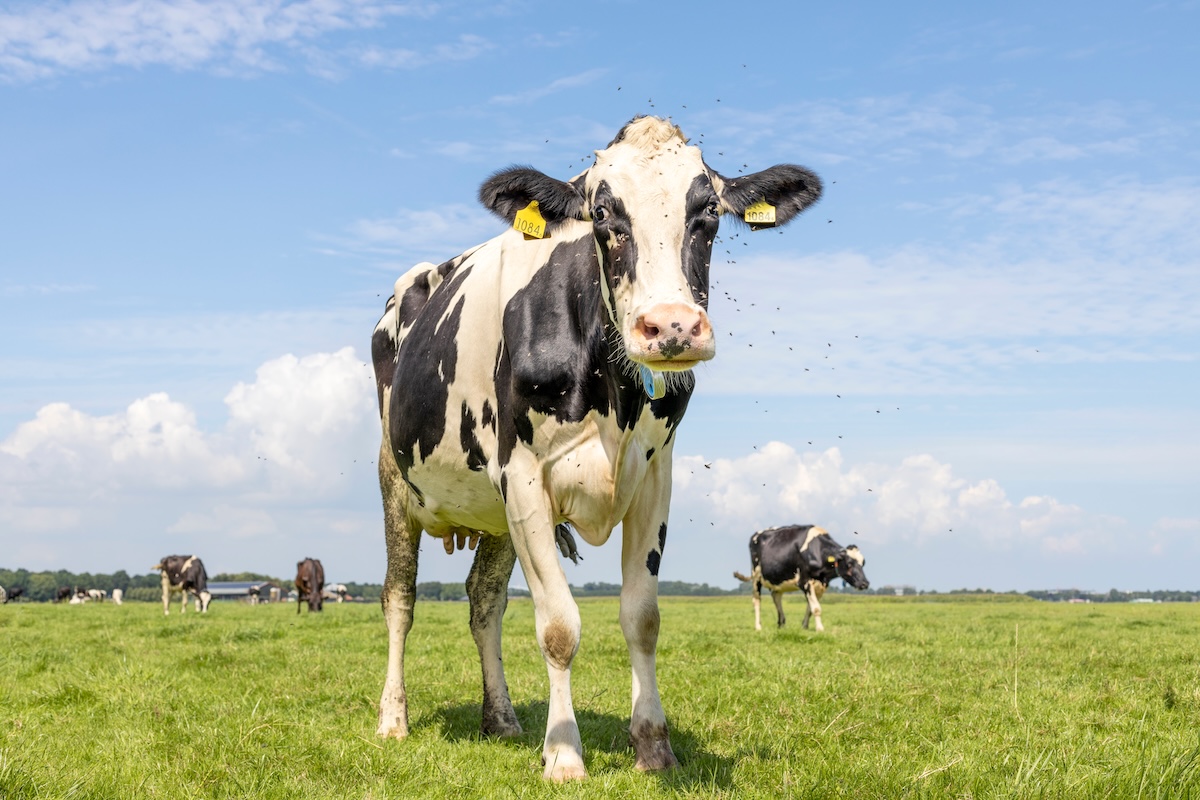
Effective fly control for beef and dairy cattle is essential to herd health, productivity, and farm profitability. Flies can reduce milk yield by as much as 20%, and infested cattle can lose 15–50 lbs in weight gain over the course of a grazing season. Feed-through fly control gives producers a way to get ahead of those losses before flies ever become a problem.
It’s no exaggeration to say that controlling flies on cows is one of the highest-ROI management decisions a producer can make. Research from North Dakota State University shows that as few as 200 flies on a single cow can cause measurable economic loss.
Read on to learn how different fly species affect cattle, how feed additives for fly control in cows work, when to start feeding them, and how they fit into a complete fly management strategy.
The Negative Impact Of Flies On Cattle Productivity
The effect of flies on cattle primarily depends on the fly species, their feeding mechanism, and the targeted body location. Understanding the differences between cattle flies can help you maximize fly control.
The most prevalent cattle fly species are:
Horn Flies
Horn flies are the most cattle-specific pest of the three. Their biology is built around a single host: cattle. They live on the animal, feed on its blood, and breed in fresh manure without ever leaving the herd. A single cow can carry thousands of horn flies at once, leading to constant irritation and significant loss of productivity.
- Appearance: Gray; look like small house flies
- Targeted location: Around horns, back, shoulders, sides, and belly
- Feed on: Cattle blood
- Deposit eggs: Into fresh manure; hatching takes 1–2 days
- Lifecycle: 10–20 days
- Feeding frequency: 20–30 blood meals per day per fly
- Health effects: Bunching, irritation, infections, and blood loss
- Productivity impact: 15–50 lbs decrease in weight gain, up to 20% milk reduction, and lower grazing efficiency, according to the University of Nebraska
Face Flies
Face flies differ from horn flies in where they gather and how they feed. Face flies cluster around the face and consume ocular and nasal secretions rather than biting for blood. Despite not being blood feeders, their impact on cattle health can be severe. The presence of just 1 to 5 face flies per eye daily is enough to cause serious ocular lesions, according to the Nebraska Extension.
- Appearance: Large; similar to dark house flies
- Targeted location: Eyes, muzzle, and mouth
- Feed on: Face secretions without biting
- Deposit eggs: Into fresh manure; hatching takes 1 day
- Lifecycle: 12–20 days
- Health effects: Pink eye (Moraxella bovis), eyeworms (Thelazia spp.), eye pain, reduced eyesight, irritation, blindness, physical eye injury, and disease transmission
- Productivity impact: Reduced pasture and feeding efficiency, and a reduction in cattle value with impaired vision; lowered weight gain and milk production
Stable Flies
Stable flies stand apart from horn and face flies because they don’t breed in manure alone — they thrive in feed waste, wet bedding, and any damp area with decomposing organic material. Beyond direct health effects, stable flies disrupt cattle behavior in ways that compound productivity loss. Affected animals often bunch together, stand in water, or lie with their legs tucked to avoid bites.
- Appearance: Very similar to house flies with distinguishing round markings
- Targeted location: Legs and lower body
- Feed on: Cattle blood
- Deposit eggs: Manure mixed with bedding, feed waste, wet straw, and silage residue; hatching in 1–4 days
- Lifecycle: 2–5 weeks
- Feeding frequency: Usually, twice a day per fly
- Health effects: Stress, irritation, blood loss, and reduced immune system performance
- Productivity impact: Lowered weight gain, milk yield, and feed efficiency
How Feed Through Fly Control Works
Feed-through fly control works by targeting flies at their most vulnerable stage: larval development in manure. Active compounds — typically insect growth regulators (IGRs) — are mixed into the animal’s feed. The compounds pass through the digestive system without being absorbed and are excreted in manure, where they prevent fly larvae from developing into adult flies.
Feed-through fly control products are subject to federal oversight. Pesticides are regulated by the Environmental Protection Agency (EPA), and the Food and Drug Administration (FDA) enforces standards for products used in animal feed.
Because horn and face flies breed exclusively in cattle manure, they are the primary targets of feed-through fly control. Stable flies, which breed in spilled silage, feed waste, and wet organic material, require additional control measures beyond feed additives alone.
When To Feed Fly Control Additives
Feed-based fly control is a preventive tool, not a reactive one. It works by interrupting the fly life cycle before the next generation of larvae can develop, which means it has no effect on flies that are already present. Starting early and maintaining consistent feeding throughout the season are essential to getting results.
Producers should begin feeding fly control additives at least 30 days before fly season arrives. Starting late puts the operation a full fly cycle behind — and while the additive will interrupt the next cycle, the herd will still experience irritation and reduced performance from the existing fly population unless other control methods are used in the interim.
Why Consistency Is Non-Negotiable For Fly Control
Feed-through products only work when manure contains a sufficient, sustained concentration of the active compound. That means every animal in the herd needs to consume the correct amount daily (dosed proportionally to body weight) without gaps in intake.
Fly control is commonly delivered via:
- Free-choice loose mineral or tubs/blocks: A fly control mineral for cattle is a common starting point, but requires careful salt and mineral management to encourage consistent, adequate intake across the entire herd.
- Supplements or complete feeds, including custom blends: Generally the most effective option, particularly when the formula is tailored to the specific nutritional needs and size of the herd.
Custom Feed With Integrated Feed Through Fly Control through Star Blends
Because feed-through fly control depends on consistent, accurate intake across every animal, the right cattle fly control feed — one custom-formulated for your herd’s size and nutritional needs — is one of the most reliable ways to ensure the program works.
Star Blends is a custom feed manufacturer that can formulate fly control additives directly into mineral and feed programs, helping operations take a proactive approach to seasonal fly pressure rather than scrambling to respond once populations have already peaked.
You or your nutritionists can connect with our team to build a feeding program that supports herd performance and keeps your operation ahead of seasonal challenges.